
Introducing the AI Equity Framework: A Blueprint for Justice in the Age of AI
After three years of running the AI Equity Project for nonprofit practitioners about their experiences with artificial intelligence, one pattern has emerged with uncomfortable clarity: AI adoption in the social sector is outpacing our ability to govern it responsibly. In 2025, 76% of nonprofit staff reported familiarity with AI, but only 15% worked at organizations with any written policy. This indicates a widening gap between use and accountability that should concern anyone who cares about equity, justice, or community power.

This is the landscape that gave birth to the AI Equity Framework.
The framework didn't emerge from theory. It came from listening: to frontline staff using free ChatGPT because their organizations couldn't afford enterprise tools; to grantees discovering their proposals were rejected by algorithms they couldn't see or question; to communities whose data was being fed into AI systems without their knowledge or consent. It came from recognizing that the nonprofit sector — whose entire purpose is to address inequity — was adopting technology in ways that reproduced the very power imbalances it exists to challenge.
The AI Equity Framework is a response to that contradiction. It's not a checklist for "doing AI nicely." It's a structural analysis of what it takes to use AI without concentrating power in the hands of those who already have it. It's six layers, each dependent on the ones below it, each essential to genuine equity. And it starts with a simple premise: AI won't fix your bias. It will scale it.
What is AI Equity?
Before we dive into the framework, let's define the term.
AI Equity is about making sure the people most affected by AI — not just the people building or funding it — have real power to shape how it's designed, used, and stopped when it causes harm.
It's the practice of redistributing power over AI systems to the communities most affected by them. It recognizes that AI is not neutral — it reflects the power structures, historical biases, and economic incentives that create it. Without intentional redistribution of authority, resources, and accountability, AI will reproduce and scale existing inequities.
AI Equity is when:
The people most affected by AI have authority over its design and use (not just consultation)
There's clear accountability when AI causes harm (not just good intentions)
Everyone involved has the resources, training, and time needed to participate meaningfully (not unfunded mandates or unpaid labor)
Data practices are grounded in consent, justice, and community benefit (not extraction)
People can see, question, and stop AI systems (not just trust them)
Power is redistributed, not just harm reduced
Each of these conditions maps directly to the six layers of the framework. Let's explore them.
Layer 1: Data Equity — The Foundation
Core Principle: Data practices must be grounded in justice, consent, and community benefit — not extraction or surveillance.
You cannot build equitable AI on inequitable data. This is the foundational truth the framework begins with. If your data reflects historical bias — if it's incomplete, extracted without consent, or collected through surveillance rather than partnership — your AI will reproduce and amplify those harms at scale.
What Data Equity looks like in practice:
A housing justice nonprofit works with residents to co-create data collection protocols, asking community members what data feels safe to share and what should never be collected. A youth-serving organization builds a consent dashboard so program participants can see what data is held about them and request deletion. A food bank audits its intake data to identify whose experiences are missing, then redesigns intake forms with multilingual community liaisons.
What it doesn't look like:
An organization using donor data from the 1990s — when its donor base was 90% white — to train AI that predicts who's likely to give. A nonprofit collecting demographic data "because the funder requires it" without explaining to clients how it will be used. A platform that claims its AI is "trained on millions of data points" without disclosing where those data points came from or whether the people they describe consented.
The hard questions Data Equity asks:
Where did your data come from?
Who is missing from your data, and why?
Can the people in your database see, correct, or delete their own data?
Did you collect this data with communities or from them?
Data equity is the foundation because everything else depends on it. Transparency about a biased dataset doesn't make the dataset less biased. Accountability for harm caused by extractive data doesn't undo the extraction. If the foundation is broken, the structure built on it will be too.
Layer 2: Transparency — Making AI Visible
Core Principle: Making AI systems explainable, auditable, and understandable to those affected by their decisions.
Transparency is about visibility. It means people can see what AI is doing, understand how it makes decisions, and know what data it's using. It's a prerequisite for informed consent and a prerequisite for accountability.
What Transparency looks like in practice:
An immigrant services nonprofit publishes a plain-language "AI Use Statement" on its website explaining which tools it uses for case management and why. A mental health organization holds quarterly community town halls where staff walk clients through how their data is used in AI-assisted risk assessments. A workforce development nonprofit creates an internal "AI register" — a living document staff can access to see every AI tool in use, its purpose, and who approved it.
What it doesn't look like:
A foundation telling grantees "We use AI to improve our process" without explaining what the AI does or what criteria it uses. A vendor claiming their algorithm is "proprietary" when asked how it makes decisions. A nonprofit using AI features embedded in their CRM without realizing those features exist or what data they access.
The hard questions Transparency asks:
If I asked "How does your AI make this decision?", could you explain it in plain language?
Do the people affected by this AI know it's being used?
Can you show me what data the AI sees when it makes a decision?
Black-box AI — systems whose decision-making processes are hidden or unexplainable — erodes trust and prevents accountability. Even well-intentioned AI becomes harmful when people can't understand or question it. Transparency doesn't mean you have to open-source your code. It means the people affected deserve to understand what's happening and why.
Layer 3: Accountability — Who's Responsible When AI Fails?
Core Principle: Establishing who is responsible when AI systems fail or cause harm, and ensuring meaningful redress.
Accountability is where transparency meets power. It's not enough to see how AI works — there must be a designated person or process responsible when it goes wrong. Without accountability, transparency is performative.
What Accountability looks like in practice:
A domestic violence organization designates a named "AI Accountability Officer" — not just a policy, but a person communities can contact if AI tools make a harmful decision. A legal aid nonprofit creates a formal grievance process so clients can report if they believe AI-assisted screening wrongly denied them services. A refugee resettlement agency conducts annual third-party audits of any AI tools used in case prioritization and publishes the findings publicly.
What it doesn't look like:
An organization that says "We'd handle it if something went wrong" but has no written process. A funder using AI to score grants with no appeal mechanism. A vendor whose Terms of Service say they're "not liable for decisions made using our tools." An organization that discovers AI is causing harm but continues using it because "we already paid for it."
The hard questions Accountability asks:
If this AI makes a mistake that harms someone, who do they talk to?
Has anyone ever complained or raised concerns about your AI use — and if not, do you have a way for them to do so?
Can you actually stop using this AI if it's causing harm, or are you locked in?
If no one is responsible when AI harms people, there is no incentive to prevent harm in the first place. Accountability isn't about blame — it's about ensuring that when systems fail (and they will), there's a path to repair and a person empowered to make it right.
Layer 4: Resource Equity — Access and Capacity
Core Principle: Ensuring all organizations — especially those serving marginalized communities — have the tools, training, and funding to engage with AI on their own terms.
You can't have participation without resources. You can't expect under-resourced organizations to "just use AI responsibly" when they're stuck with free tools, no training budget, and no time for governance. Resource equity recognizes that equitable AI requires equitable investment.
What Resource Equity looks like in practice:
A BIPOC-led environmental justice nonprofit advocates to a funder that AI capacity-building be a funded line item — not expected to come from existing operating budgets. A rural health nonprofit joins a regional data cooperative with peer organizations to share the cost of ethical AI tools and a shared data analyst. A community foundation creates a dedicated "AI Equity Fund" that smaller grantees can access specifically for staff training, tool assessment, and community engagement — not just tool adoption.
What it doesn't look like:
An organization using free ChatGPT because they can't afford Microsoft 365 Copilot — exposing sensitive client data to a tool with no privacy guarantees. A funder requiring grantees to "leverage AI" without funding the capacity to do so responsibly. Staff paying for AI subscriptions personally because their organization won't. Expecting frontline workers to learn AI "on their own time."
The hard questions Resource Equity asks:
Are any of your staff paying for AI tools personally (not reimbursed)?
If we asked your staff "Do you have adequate training and time to use AI responsibly?", what would they say?
Did you budget for AI governance (policies, training, oversight) or just the tool itself?
Resource disparities create a two-tiered system: well-resourced organizations use AI safely while under-resourced organizations — often serving the most vulnerable communities — are pressured to adopt without support. That's not just unfair. It's structurally dangerous.
Layer 5: Co-Design & Participation — Shared Authority
Core Principle: Ensuring that communities and practitioners who will be affected by AI systems have meaningful authority in shaping how those systems are designed, deployed, and governed.
Participation is not consultation. It's not "We talked to community members and they seemed fine with it." It's shared decision-making power. It's the ability to say no. It's co-design with teeth.
What Co-Design looks like in practice:
A disability rights organization forms a "Community Tech Council" — paid members of the communities it serves who review and approve any new AI tools before adoption. A child welfare nonprofit invites current and former youth in care to help design the criteria used in an AI-assisted needs assessment — giving them real editing power over the algorithm's logic. A housing nonprofit builds a multilingual co-design process where tenants in multiple languages shape how AI is used to track maintenance requests, with a formal feedback loop that can halt tool use if community members flag harm.
What it doesn't look like:
An organization adopting AI and then asking for feedback. Leadership making AI decisions and calling it "inclusive" because they mentioned it in a newsletter. A funder creating an AI-powered grant scoring system and surveying grantees after it's already built. Consulting communities but having no mechanism for their input to actually change anything.
The hard questions Co-Design asks:
Before adopting this AI, did you ask the people it would affect if they wanted it?
Can the people affected by this AI actually say "no" or halt its use?
Who was NOT in the room when you decided to use AI — but should have been?
Inclusion without power is tokenism. If community members can give input but can't change the outcome — if they can advise but can't veto — you don't have co-design. You have a focus group.
Layer 6: Power & Self-Determination — The Goal
Core Principle: Centering community power and ensuring that those most affected by AI have ultimate authority over its design, deployment, and governance.
This is the outer layer. The goal. The vision of what AI equity actually looks like when it's fully realized. It's not about making AI extraction more polite — it's about redistributing power so that communities control the systems that affect them.
What Power & Self-Determination looks like in practice:
An Indigenous-led nonprofit negotiates data sovereignty agreements with any vendor or funder — asserting that tribal data belongs to the nation and cannot be used to train AI models without explicit, ongoing consent. A Black-led advocacy organization builds its own community-controlled data platform — refusing to rely on third-party AI tools that extract community data for profit — and trains staff and community members to maintain it. A network of grassroots nonprofits collectively lobbies a city government to require community benefit agreements before any AI is deployed in publicly-funded social services — shaping policy rather than just responding to it.
What it doesn't look like:
An organization saying "We're using AI to help our community" when the community had no say in that decision. A funder implementing AI in grantmaking to "reduce bias" without asking grantees if they trust the system. A vendor claiming their AI is "for social good" while retaining ownership of all customer data. Efficiency improvements that benefit the organization but burden or surveil the community.
The hard questions Power & Self-Determination asks:
Who ultimately controls the AI that affects your work — you, a vendor, or a funder?
Is this AI helping you build community power, or just making your operations more efficient?
If this AI is working well for you but harming the people you serve, what would you do?
AI equity is not about doing AI better. It's about asking whether AI serves justice — and being willing to walk away when it doesn't.
Why the Layers Matter: You Can't Skip Steps
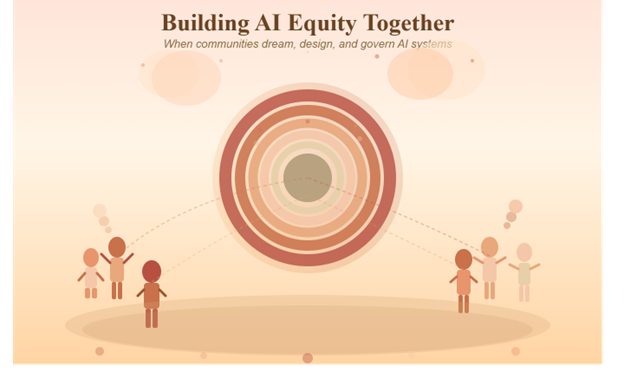
The AI Equity Framework is structured as concentric circles for a reason. Each layer depends on the ones inside it. You cannot have community power (Layer 6) without co-design (Layer 5). You cannot have meaningful co-design without resource equity (Layer 4). You cannot ensure resource equity without accountability (Layer 3), transparency (Layer 2), and data equity (Layer 1).
Organizations often want to jump to the outer layers — "We'll include community voice!" — without building the foundation. But inclusion without transparency is superficial. Transparency without accountability is performative. Accountability without resources is an unfunded mandate. And all of it collapses if your data foundation is broken.
The framework forces you to start at the center and work outward. It's uncomfortable because it reveals gaps. It's clarifying because it shows you where to begin.
How to Use This Framework
The AI Equity Framework is not a certification. It's not a scorecard. It's a diagnostic tool and a North Star.
Use it to audit your current AI use: Go through each layer and ask the hard questions. Where are your gaps? What's missing? Be honest.
Use it to decide where to start: Most organizations will find they're missing multiple layers. Start with data equity and transparency — the foundation. You can't build the rest without them.
Use it to push back on harmful AI adoption: When a funder, vendor, or board member pressures you to adopt AI, use the framework to articulate what's needed. "We can't do this responsibly without [Layer X]. Here's what we need."
Use it to advocate for systemic change: The framework reveals structural problems — resource gaps, power imbalances, missing accountability. These aren't individual failures. They require sector-wide solutions.
What the AI Equity Project Research Tells Us
Over three years, the AI Equity Project has documented a troubling pattern:
Adoption is outpacing governance. People are using AI faster than organizations are creating policies, and the gap is growing.
Resources are unevenly distributed. Large organizations get enterprise tools with privacy protections. Small organizations — often serving the most vulnerable communities — get free tools with no safeguards.
Pressure is high, support is low. 54% of nonprofit staff feel pressure to adopt AI from funders, boards, or peers. Only 19% have adequate training and support.
Power is concentrated. 62% of AI decisions are made by executive leadership. Just 4% include community members or frontline staff.
Accountability is unclear. 47% of organizations have no idea who would be responsible if AI caused harm.
These are not isolated problems. They're symptoms of a structural issue: the nonprofit sector is adopting technology designed to optimize and scale — without asking whether optimization and scale serve justice.
The AI Equity Framework is a tool for asking that question. And for building something different.
So what is our goal here: Redistribution before Optimization
AI equity is not about using AI more efficiently. It's not about reducing bias in algorithms. It's not about making extraction kinder.
It's about power. Who has it. Who doesn't. And whether we're willing to redistribute it.
The AI Equity Framework is a roadmap for that redistribution. It won't be comfortable. It will reveal gaps in governance, resources, and values. It will require investment, humility, and sometimes the willingness to say "not yet" or "not this way."
But if we're serious about equity — if we genuinely believe that technology should serve justice rather than replicate harm — then we have to start somewhere. And that somewhere is with an honest accounting of where power sits and a commitment to moving it toward the people who've been excluded from it.
The framework is now yours. Use it. Question it. Adapt it to your context. Share it with your funders, your vendors, your peers. Make it a standard, not an aspiration.
Because AI is already here. The only question left is whether we'll govern it — or let it govern us.


Comments